
How many toilets does a farm crew need?
OSHA field sanitation standard 1928.110 sets the number for hand-labor agricultural work: one facility per 20 employees, and it has to sit within a quarter mile of wherever people are working, not back at the barn. That is different from the construction ratio under OSHA 1926.51(c), which allows 1 toilet per 20 workers up to a point, then adjusts as headcount climbs. Most Greenville farm operations we work with land somewhere between one and four standard units depending on how spread out the fields are and how many crews rotate through in a day. If your crew moves field to field, you may need a second cluster rather than one central bank of toilets, since the quarter mile rule follows the workers, not the property line. We help owners figure the count with a quick walk of the acreage, the same way we do for construction site services elsewhere in Greenville. Potable water matters here too. OSHA 1926.51(a)(1) requires an adequate supply of drinking water at any place of employment, farm fields included, so we often pair toilets with a handwashing station rental or a standalone portable sink rental rather than leaving crews to guess.
What about handwashing during spraying season?
Handwashing is required specifically around chemical exposure. OSHA 1926.51(f)(1) calls for washing facilities where workers apply pesticides, herbicides or other harmful contaminants, which covers a lot of the spring and summer calendar on a working farm. That is a narrower rule than general sanitation. It only kicks in with paints, coatings, herbicides or insecticides, so it does not replace the toilet count under 1928.110, it sits alongside it. We stock units that meet 29 CFR 1910.141(d)(2), which requires soap and a way to dry hands, not just sanitizer, since hand sanitizer alone does not satisfy that rule. For crews doing chemical application near Greenville, we usually place a hand sanitizer station rental as a supplement between full washing setups, never as the only option. If your operation is closer to Simpsonville or out toward Easley, 14.3 miles west of Greenville, the same rule applies regardless of address; distance from town does not change the standard, only our delivery routing does.
Do farms need permanent or portable holding tanks?
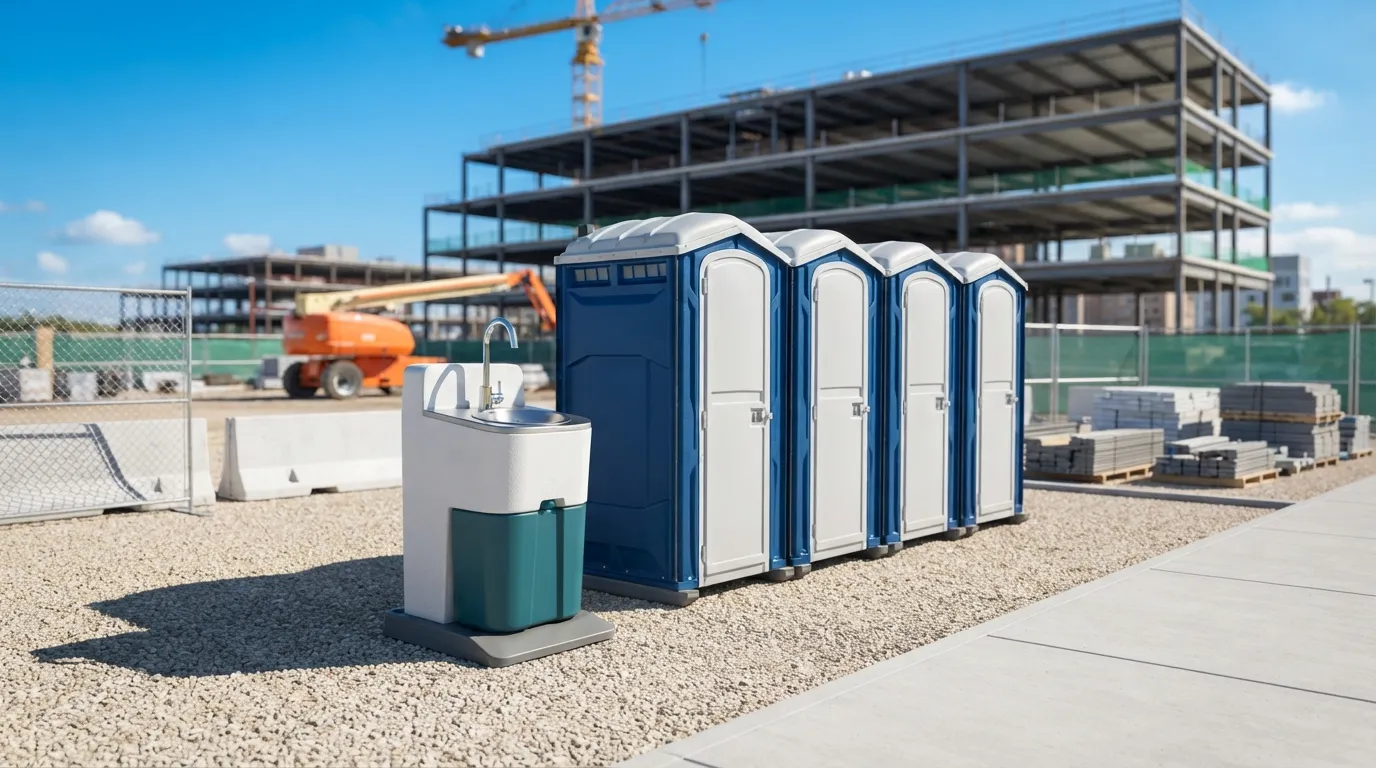
Portable holding tanks work for most seasonal and rotational needs, and permanent ones rarely make sense unless you have year-round labor housing on site. A holding tank rental gives you a self-contained option where there is no septic line to tie into, which describes a lot of remote field edges around Greenville. Standard units carry a 60 to 70 gallon holding tank and stand about 92 inches tall on a 44 by 48 inch footprint, small enough to place near a field access road without blocking equipment. If your farm already runs a septic system for a farmhouse or packing building, that is a separate conversation. A residential septic tank is typically pumped every 3 to 5 years depending on tank size and household size, and our septic pumping service handles that on its own schedule, distinct from the portable units in the fields. Farms running commercial kitchens or processing sheds should also ask about grease trap pumping, since a grease interceptor needs servicing once fats, oils, grease and solids reach 25 percent of the liquid depth, a threshold that sneaks up fast during harvest season.
| unit | duration | typical price |
|---|---|---|
| standard | week | $200 |
| standard | month | $200 |
| service_fee | week | $60 |
Weekly and monthly standard rates sit close together for farm accounts because most contracts run the full season rather than a single week, and our monthly porta potty rental page breaks down how that billing works. For shorter jobs, like a single harvest weekend, check porta potty rental per day instead. See full detail on porta potty rental cost before you commit to a term.
Greenville farms that also run u-pick events or seasonal markets should look at event restroom rental for the public-facing side, since crew sanitation and visitor sanitation are two different plans. For county fair vendors nearby, county fair restrooms covers that separately.
Can one portable toilet cover a whole farm?
Rarely, once the operation covers real acreage. The quarter mile walk limit under 1928.110 means a single unit near the barn does not count if crews are three fields away. Most Greenville operations need at least two clusters positioned near active work zones, checked against our porta potty placement guide.
How often are farm units serviced?
The baseline is one visit per week for up to 10 users over a 40 hour week, per ANSI/PSAI Z4.3. Heavier crews or spraying season may need twice-weekly service. See how often are porta potties cleaned for the full breakdown.
Do we need an ADA unit for farm workers?
Only if the cluster is open to the public, like a farm stand or agritourism event. ADA Standards 213.2 requires at least 5 percent of clustered units be accessible. Pure field labor crews are governed by 1928.110 instead. Details at ADA accessible porta potty.
What if our farm is outside Greenville proper?
We still deliver. Greer sits 11.4 miles northeast and Mauldin 6.9 miles southeast, both within normal routing. Check service areas or request a quote directly for confirmation on your address.
Can we combine toilets with a dumpster for harvest cleanup?
Yes. Many farms pair units with a roll-off dumpster rental during harvest for packaging waste and crop debris, scheduled on the same delivery run to save a trip.
Next step
Get a delivery date
Tell us the address, the dates and the headcount. We size the order and confirm the route.