
How many restrooms does a Greenville marathon need?
Runner count drives the number, but course layout drives placement. A start line with 500 runners waiting in the cold needs more units than a finish line where people scatter fast. OSHA 1926.51(c) sets construction toilet ratios by crew size, and while a road race isn't a job site, race organizers in Greenville use similar per-person math to size restroom counts for staging areas, water stops and the finish chute. A standard unit rents for between 250 and 400 dollars over a weekend, which covers most single-day races with room for course support. Larger events add deluxe flushable units near VIP tents or sponsor villages, and any race expecting wheelchair participants needs at least one accessible unit per cluster under ADA Standards section 213.2, which requires 5 percent of clustered units to be accessible with never fewer than one. We map placement against your course map before quoting, the same way we would for a festival or a golf tournament spread across acreage instead of a mile marker.
Course aid stations near mile 3, mile 7 and the finish typically each need their own small cluster rather than one big bank at the start. Races that loop back through downtown Greenville twice can often share a single midpoint cluster for both passes, cutting total unit count without cutting coverage. We've serviced races that overlap with routes through City View, about 5.5 miles northwest of downtown, and courses that stretch toward Mauldin, 6.9 miles southeast, so we plan drop points around whichever direction your course runs.
What does race restroom placement cost?
Placement cost depends on unit count, duration and whether you need delivery to multiple course points instead of one central lot. Race organizers usually rent by the weekend since most marathons run Friday setup through Sunday teardown.
| Item | Weekend Price Range |
|---|---|
| Standard unit | 125 to 400 dollars |
| ADA accessible unit | 199 to 300 dollars |
| Deluxe flushable unit | 85 to 1200 dollars (day rate, ask for weekend quote) |
| Delivery fee | 125 to 540 dollars |
Multiple drop points across a long course mean multiple delivery fees, so a 10K with three restroom clusters costs more in delivery than a single-cluster 5K even with the same total unit count. We build the quote around your actual course map, not a flat per-unit number, and we'll tell you where a porta john rental at a mile marker beats hauling everyone back to one central lot. For races that also need lighting at pre-dawn start lines, we handle that alongside restrooms; ask about light tower rental if your start time is before sunrise. Some finish-line festivals run generators and light towers off the same temporary power setup, and knowing how to brace a temporary power pole against wind and foot traffic matters as much as the restroom count itself. A pole set on soft turf near a finish chute needs a stable base and guy lines rated for the load, the same way any freestanding structure near a crowd does; we set poles the way we'd set crowd control barrier rental, anchored before runners or spectators are ever near it.
Do race organizers need permits for restroom placement?
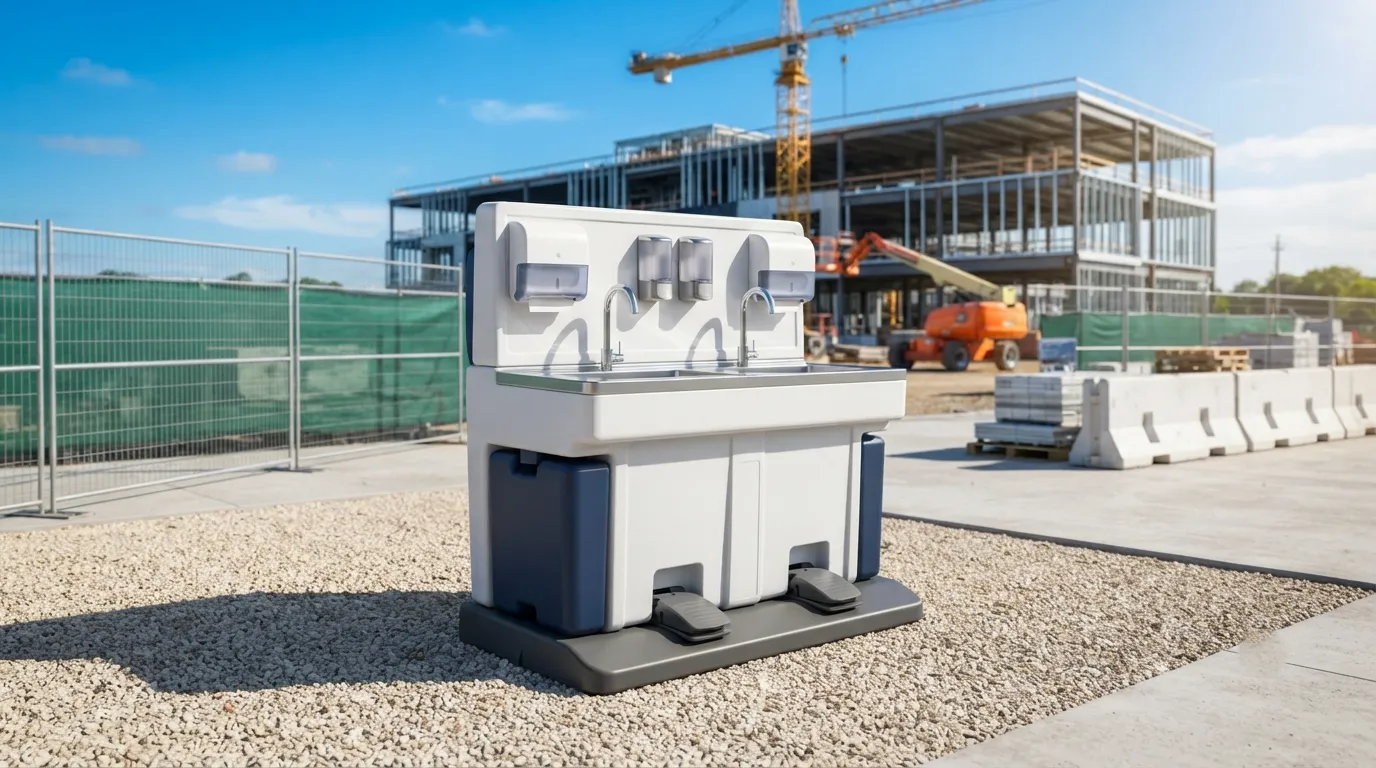
Placement in public right of way, closed streets or city parks needs confirming with the City of Greenville before race day, and we can't state a blanket permit rule here because requirements vary by course and by whether the route crosses city versus county property. We've handled restroom placement for routes that pass near Mauldin and Simpsonville, 14.0 miles southeast, where a single race sometimes crosses two municipal boundaries, and each jurisdiction can have its own rule on where a unit sits relative to a curb or crosswalk. Check our porta potty permit requirements guide for the questions to ask your city contact, and see our full porta potty placement guide for spacing and access rules that apply regardless of jurisdiction. We also stage handwashing station rental units at aid stations since runners handling gel packets and sports drinks benefit from a sink, not just sanitizer, under 29 CFR 1910.141(d)(2), which requires soap and towels rather than sanitizer alone at fixed handwashing facilities.
How far in advance should we book race restrooms?
Book as soon as your course map is final, ideally 60 to 90 days out for races over 500 runners. Units and delivery trucks fill fast on peak race weekends in spring and fall. See our event restroom rental page for general lead times across race and festival bookings.
Can we place restrooms at multiple points along the course?
Yes, and most races over a 10K should. We coordinate delivery to the start, midpoint aid stations and the finish separately, each with its own porta potty rental cluster sized to expected crowd density at that point.
Do we need an accessible unit at every cluster?
Yes. Any cluster of units needs at least one accessible restroom under ADA Standards 213.2, even a small three-unit aid station. We size accessible unit counts per cluster, not just per race.
What happens if the race runs long and units need servicing mid-event?
We schedule a service truck on standby for races over four hours, so units get serviced between waves without shutting down access. Ask about mid-event service when you request your quote.
Can we rent restrooms for just the finish line festival after the race?
Yes, and many organizers add standard porta potty rental units or a restroom trailer rental just for the post-race festival, priced separately from course restrooms since crowd size and duration differ.
Next step
Get a delivery date
Tell us the address, the dates and the headcount. We size the order and confirm the route.